Garvey Labs Logo

The Grid-Positive Community Integration Framework

A proprietary methodology for helping communities capture the data center economy as lasting community wealth — before developers define the terms.

Developed by Garvey Labs and applied across history overlooked markets and communities in the South and Northeast, the Grid-Positive Community Integration Framework is the only pre-negotiation leverage methodology designed specifically for communities competing for participation in the data center economy. It is organized around five non-negotiable standards that together define a community wealth architecture.

Five Non-Negotiable Standards

A Community Wealth Architecture for the Data Center Economy

No engagement is complete without all five. A community that captures infrastructure benefits but lacks environmental accountability cannot verify those benefits over a 20-year facility life. A community with workforce commitments but no cost accountability has traded jobs for ratepayer burdens. A community with both but no governance standard has no enforcement body.

The Floor

Developer Cost Accountability Standard

Every public cost a project creates, including grid upgrades, water and wastewater infrastructure, road damage, and public safety load, is contractually assigned to the developer. PIAT (Payment in Addition to Taxes) is the default structure: full assessed property taxes plus a negotiated community benefit payment. Costs are reconciled annually against actual cost-of-service data and are never socialized through ratepayer increases or municipal general funds. Garvey Labs delivers a formal cost-burden analysis in every engagement, giving clients the leverage to hold the standard.Garvey Labs delivers a formal cost-burden analysis in every engagement, giving clients the leverage to hold the standard.
The Infrastracture Ceiling

Grid-Positive Community Integration Standard

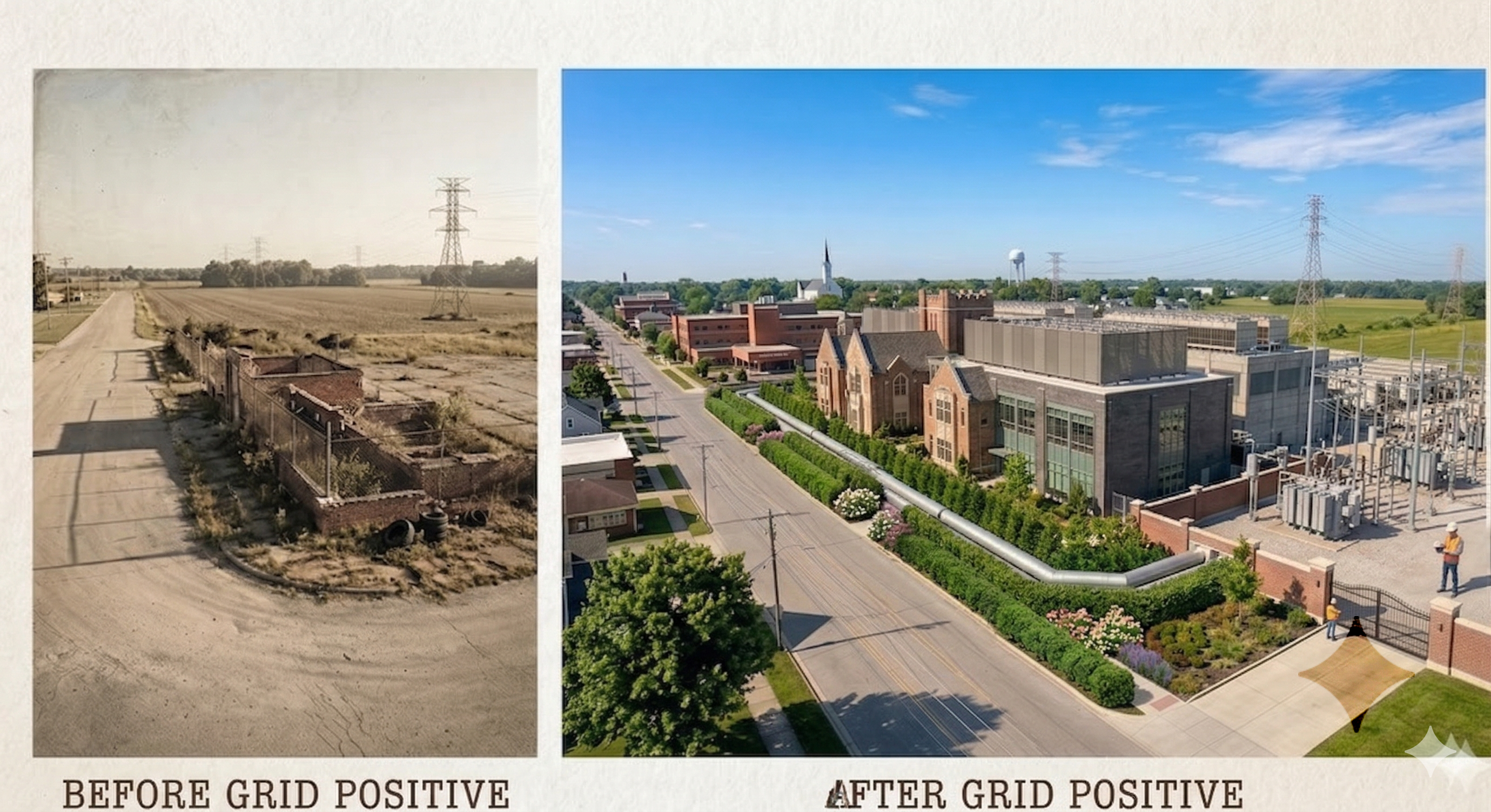
Data centers invest in substations, battery storage, standby generation, and grid redundancy as operational necessities — not community gifts. The Grid-Positive Community Integration Standard structures those investments as community assets: interconnected to the public grid, governed by a community advisory board, and extended to residents through a Community Virtual Power Plant program.

The Human Capital Ceiling

Community Workforce Investment Standard

Data center development should create pathways into career-grade, transferable employment — not temporary construction jobs. This standard requires local hire commitments, developer-funded pre-apprenticeship programs run by IBEW JATC affiliates, and apprenticeship completion support through the full 4 to 5 year union program, ensuring residents gain meaningful career opportunities.

The Environmental Floor

Environmental Accountability Standard

Environmental limits are monitored, not assumed. Non-potable water is the default for cooling, with municipal reclaimed water prioritized where infrastructure exists, and the host wastewater authority confirms discharge volumes and treatment capacity in writing. Developers publish annual Carbon Usage Effectiveness and Water Usage Effectiveness data, disclose PFAS, certify e-waste disposal, and provide groundwater monitoring. Operational noise is capped at 55 dB(A) by day and 45 dB(A) at night, with limits on low-frequency sound. A pre-development residential valuation baseline and cultural resource survey are required, plus a health impact assessment in environmental justice corridors.

The Community Standard

Community and Civic Engagement Standard

A Community Advisory Board is the enforcement body for all five standards. It is constituted before the development agreement is signed, with at least 60% of seats held by community institutions and no developer representation. At most one economic development organization seat is allowed, non-voting where that organization has a financial interest. The framework also requires a public data dashboard, a plain-language annual report to every household within one mile, and a grievance process with non-retaliation protection. A developer that conditions RFP participation on a community-side NDA is treated as a non-responsive bidder.

Behind-the-Meter StandardNew in v2.16

When the Data Center Brings Its Own Power Plant

When the grid can't deliver power on the developer's timeline, more developers are building their own. That turns a data center application into a power plant application. The Behind-the-Meter Standard sets the terms for on-site generation (turbines, engines, storage, or renewables) and applies across all five standards.

Transparency

The community sees what the plant burns, emits, and plans, on a public schedule.

Best Practice

Permitted before it runs, built to the strongest proven controls, and adopting cleaner power the moment an independent test shows it competes on cost.

Accountability

Commitments carry a defined consequence and bind any future owner or operator.

The model: built ready, phased in on a public test, backed by a known cost.

Full Behind-the-Meter provisions are part of the Grid-Positive methodology and are applied in each community engagement.

Framework version: Executive Framework v2.16b, May 2026. Companion to Methodology v2.16a.

Designed for the Communities That Need It Most

The Grid-Positive Community Integration Framework was developed specifically for historically overlooked markets and communities under 150,000 residents in the South and Northeast — the communities that have been most overlooked by the first decade of data center development, and the communities that have the most to gain from the next chapter. These communities have transmission infrastructure, available industrial land, and fiscal motivation. What they have lacked is a framework for converting developer interest into community wealth. That is what this methodology provides.

Five standards of the Grid-Positive Community Integration Framework: Developer Cost Accountability, Grid-Positive Community Integration, Community Workforce Investment, Environmental Accountability, and Community and Civic Engagement, enforced by the Community Advisory Board.

Apply the Framework to Your Community

The Grid-Positive Community Intelligence Brief is the entry point — a 7-business-day proprietary intelligence product that applies the framework to your specific jurisdiction and shows exactly where your community stands, what the opportunity looks like, and what the next step requires. All Garvey Labs analysis is built on rigorous analytical backing — verifiable data, unbiased conclusions, and documented sources. Every quantified finding cites a citable source. Conclusions reflect what the data supports, not what any party wants to hear. This standard applies regardless of who commissioned the work or who funded it.